Dry Bag for Monsoon Commuting: Packing and Sizing Guide
A monsoon commute is not a wet commute in the European sense: tropical downpours deliver 25 to 100 mm of rain per hour against the 2 to 5 mm of a temperate shower, and kerbside standing water reaches 100 to 200 mm within twenty minutes of the peak. That combination needs a 20 to 25 litre bag with welded seams rated IPX6 or better, a separate 5 to 10 litre inner roll-top for the laptop, and a packing order that lets you close the bag in under fifteen seconds at a bus stop.
The guide below translates those conditions into decisions: how much rain the rating has to cover, how many litres a workday actually needs, which format survives a crowded train, how to keep a laptop dry through two independent barriers, and what to do with a soaked bag when you reach the office. Every figure is tied to something you can measure on your own route, from rain rate to the depth of the puddle at the corner.
- What monsoon rain does that ordinary rain does not
- How many litres a workday actually needs
- Backpack, tote or duffel for a crowded commute
- Laptop and documents: two barriers, always
- Closing the bag in fifteen seconds at a bus stop
- Condensation and the humidity problem
- The bottom 200 mm: flooding, kerbs and traffic spray
- Fabric, colour and being seen
- Packing order for a wet arrival
- The office routine and the evening reset
- What fails first on a monsoon commute
- Choosing a monsoon setup: the checklist
What monsoon rain does that ordinary rain does not
Three properties separate a monsoon downpour from a temperate one, and each breaks a different assumption. Intensity is the obvious one: 25 mm per hour is a heavy tropical shower, 50 mm per hour is a downpour that overwhelms urban drainage, and above 80 mm per hour the water on the road is moving rather than standing. The second is droplet size, because tropical convection produces larger drops with more momentum, which defeats loosely woven shells that shed fine drizzle perfectly well.
The third is duration combined with humidity. A monsoon cell can run for two hours at a time when you are walking to a station, and ambient humidity of 80 to 95% means nothing dries while you travel: a bag that gets wet at 08:00 is still wet at 18:00. That is why the drying routine at the office matters as much as the rating on the bag, and why condensation becomes a daily problem rather than an occasional one.
| Rain rate | What it feels like on the street | Rating that holds | Seam requirement |
|---|---|---|---|
| 2-5 mm per hour | Drizzle, umbrellas optional | IPX4 | Coated or welded |
| 10-25 mm per hour | Steady rain, gutters running | IPX5 | Welded |
| 25-50 mm per hour | Downpour, drainage overwhelmed | IPX6 | Welded |
| 50-100 mm per hour | Sheets of water, road flooding | IPX6 to IPX7 | Welded, 0.5 mm film |
| Standing water 150 mm | Kerbs, potholes, bus splash | IPX7 | Welded, closure up |
Read the bottom row carefully, because it is the one that catches commuters out. Spray from a bus passing through 150 mm of standing water arrives horizontally at waist height and hits the closure area rather than the top panel, so a bag that is fine in vertical rain can take water through the roll-top if the fold is on the traffic side. Turn the closure inward, toward your back, and the same bag stays dry.
How many litres a workday actually needs
Commuting loads are dominated by one heavy, flat object and a set of small ones. A 14-inch laptop with its charger packs to about 2.5 litres and 2.0 kg; a folder of documents, a notebook and a wash bag add 2.5 litres; a change of clothes for the office adds 4 to 6 litres if you cycle or walk any distance. That puts most people between 12 and 18 litres of real volume, which is why a 20L bag rather than a 30L is the correct starting point.
| Item | Packed volume | Weight | Where it goes |
|---|---|---|---|
| 14-inch laptop and charger | 2.5 L | 2.0 kg | Inner 5L roll-top, against the back panel |
| A4 documents in a folder | 1.8 L | 700 g | Inner sleeve, flat, spine down |
| Notebook and pens | 0.8 L | 400 g | Main compartment |
| Light change of clothes | 4.5 L | 900 g | Main compartment, rolled not folded |
| Wash bag and towel | 1.6 L | 450 g | Main compartment |
| Lunch and a 500 ml bottle | 1.7 L | 900 g | Side or outer pocket |
| Umbrella, wet | 1.2 L | 350 g | Outside the bag, in a wet sleeve |
Notice what is missing from that list: nothing belongs outside the sealed volume except the umbrella. A wet umbrella inside a dry bag is exactly the same problem as a wet wetsuit, and the fix is the same, a 5L external wet sleeve that drips outside rather than in. Volume guidance for the sizes most commuters end up choosing is in what fits in a 20L bag and what fits in a 15L bag.
Backpack, tote or duffel for a crowded commute
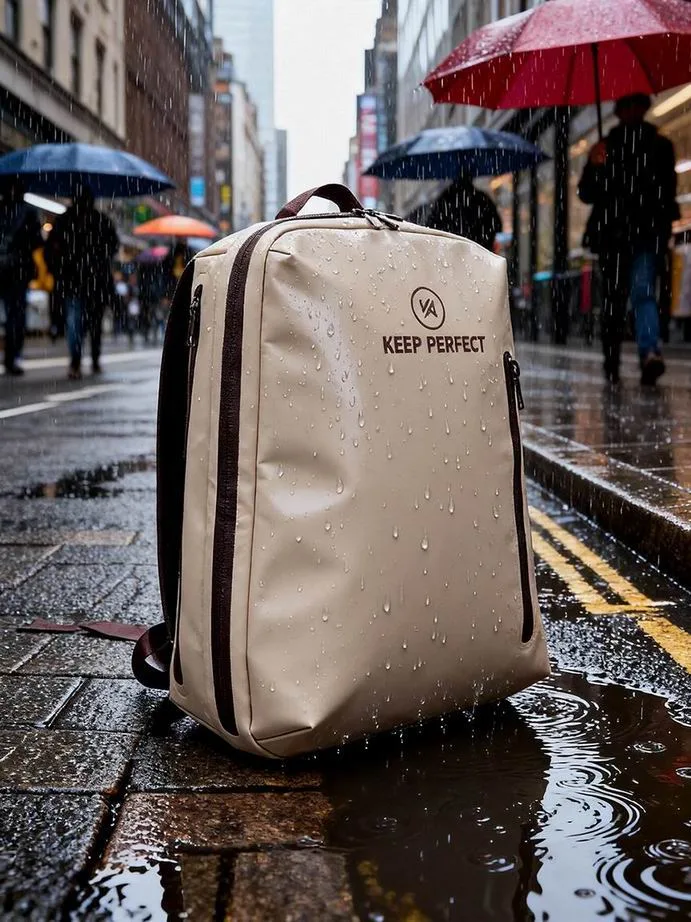
Format is decided by how you travel, not by how much it rains. If you walk or cycle, a waterproof backpack with a welded harness is the only sensible choice, because you need both hands for an umbrella, a phone or handlebars, and because a 4 kg load on one shoulder for 3 km is a posture problem. If you travel by car or ride-hailing and only walk 200 m at each end, a waterproof tote with a padded sleeve is faster to open and easier to set on a desk.
| Format | Typical volume | Monsoon strengths | Limits | Best for |
|---|---|---|---|---|
| Waterproof backpack | 20-30 L | Hands free, even load, back panel padding | Slower to open, warm back | Walking and cycling commutes |
| Waterproof tote | 15-22 L | Fast access, sits on a desk, laptop sleeve | One shoulder, swings in wind | Short walks, car commutes |
| Roll-top dry duffel | 25-40 L | Cheap, huge, compressible | No back panel, poor on a train | Gym kit and overflow |
| Dry sack inside a pack | 10-20 L | Protects contents if the shell wets | Two-step access | Backup layer for any format |
| Messenger with welded flap | 15-20 L | Swings to the front on a train | Uneven load over 2 km | Mixed rail and walk |
The hybrid that most commuters converge on is a dry sack inside a normal work backpack. It costs 150 g, it means the bag you carry into a meeting looks like a work bag, and it protects the load even if the outer shell wets through during a forty-minute walk. The alternative comparison is set out in waterproof backpack versus dry bag liner and backpack versus duffel.
Laptop and documents: two barriers, always
A laptop is the single item that justifies the whole system, and it should never rely on one seal. The working rule is two independent barriers: a padded 5 to 10 litre inner roll-top or sleeve with welded seams, carried inside the main 20L bag against the back panel. Two barriers matter because the failures are independent: grit in the main fold does not reach the inner bag, and a puncture in the outer shell does not either.
Documents need a different treatment because they fail from moisture rather than immersion. Put paper in a rigid folder, then in a flat inner sleeve, and keep the spine downward so any water that does arrive runs along the gutter rather than into the pages. Add a 10 g desiccant sachet if you commute at 90% humidity for weeks, and read the fuller treatment in protecting a laptop and documents and passport protection.
Closing the bag in fifteen seconds at a bus stop
Closure discipline is where most monsoon commuters lose, because the bag has to be opened and shut in the rain, usually while holding something else. Practise the sequence until it is automatic: set the bag down on your foot rather than on the pavement, open with the closure facing your body, take out or put in one thing, press the air out, roll three times away from the traffic, clip, and stand up. Fifteen seconds is realistic with practice.
Two details make the difference between a dry interior and a damp one. Never set the bag on the ground at a bus stop, because the bottom 150 mm is where the standing water is, and never leave the mouth open while you search: unpack into your hand, close, then sort. If you commute by scooter or bicycle, add a bungee or a strap across the roll so the closure cannot work loose over 20 minutes of vibration at 40 km/h.
Condensation and the humidity problem
Commuters are often baffled to find a damp laptop sleeve inside a bag that never leaked. The mechanism is the dew point: air sealed inside at 30 °C and 90% humidity, then carried into an office at 22 °C, deposits water on the coolest surface it can find, which is usually the metal shell of the laptop. A 15L bag in those conditions can drop 5 to 10 ml overnight, which is enough to mark paper and fog a screen.
The countermeasures are simple and cumulative. Keep anything damp outside the sealed volume, press the air out before rolling, use a purge valve if the bag has one, and carry 10 to 20 g of desiccant in the electronics pouch. Desiccant is cheap and needs regenerating rather than replacing: an hour in a warm oven at 100 °C restores it. The full explanation is in condensation inside a dry bag.
The bottom 200 mm: flooding, kerbs and traffic spray
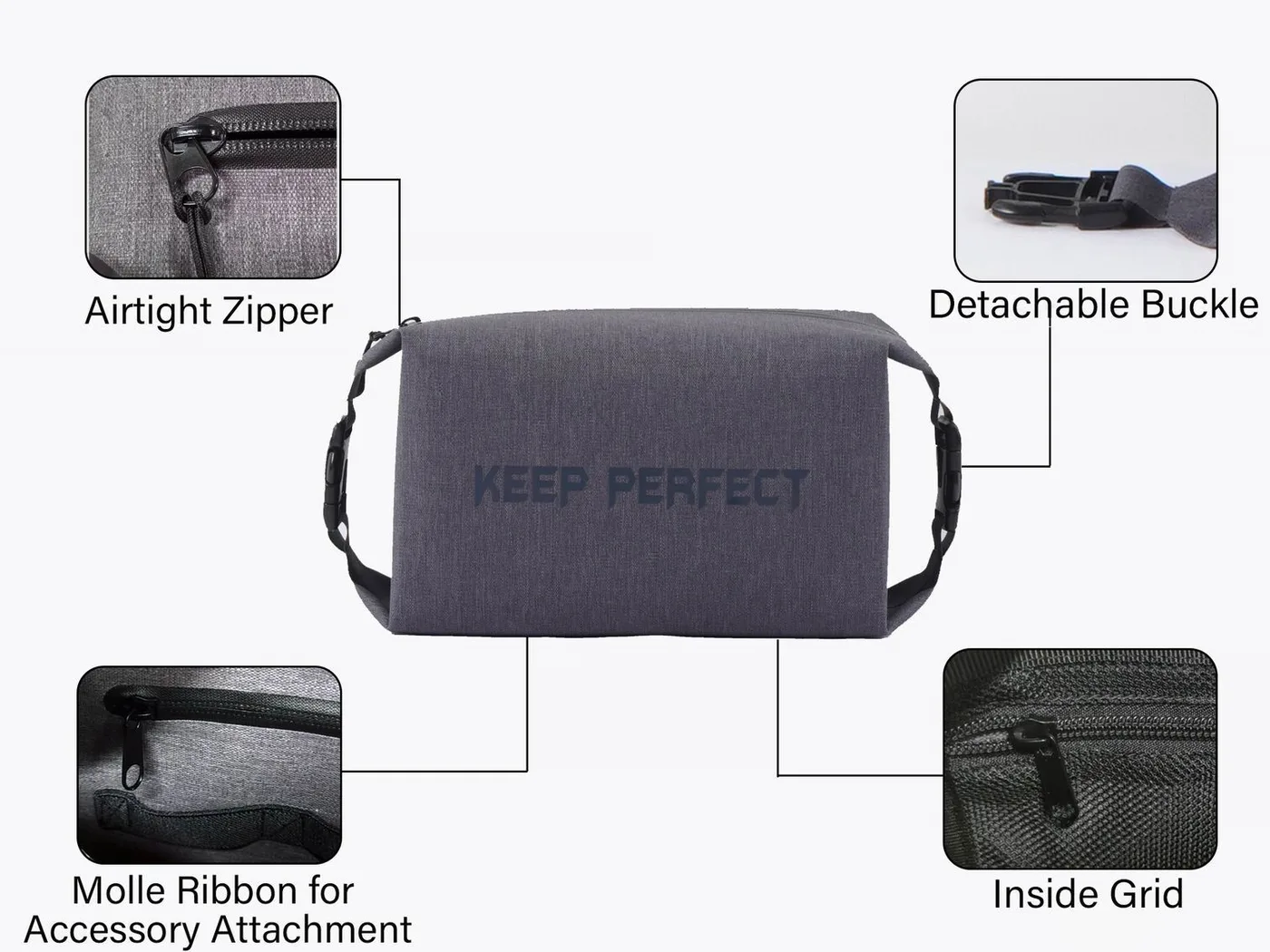
Almost all commute wetting happens low down, not up top. Kerbs, potholes and bus spray put water at 100 to 200 mm above the road surface, which is the base of a bag carried at hip height or set down for a moment. Reinforcement at the base is worth more than reinforcement anywhere else: look for a double-layer bottom panel, a welded rather than stitched base seam, and feet or a flat panel that keeps the weld off the pavement.
Carry height matters too. A backpack worn high, with the base above 400 mm from the ground, is clear of almost all splash except the direct plume from a passing bus; the same bag slung low on one strap puts its base into the splash zone with every step. If you set the bag down at all, put it on a wall, a step or your foot, and never on the road or the pavement at a junction.
Fabric, colour and being seen
For daily commuting, film thickness of 0.4 to 0.5 mm with a 420D or 500D face is the sensible balance, adding roughly 90 g over a 0.3 mm build on a 20L bag while roughly tripling the abrasion life against office furniture, train floors and scooter footwells. The face fabric also decides how the bag looks after six months: a 500D weave resists the scuffing that makes a daily bag look tired long before it stops working.
| Choice | Weight on a 20L bag | Abrasion cycles | Practical note |
|---|---|---|---|
| 0.3 mm film, 210D face | 320 g | 3,000-4,000 | Light, but scuffs within a season |
| 0.4 mm film, 420D face | 410 g | 6,000-8,000 | Good daily balance |
| 0.5 mm film, 420D face | 480 g | 10,000-14,000 | Best for a bag used every day |
| 0.5 mm film, 500D face | 540 g | 12,000-16,000 | Best for scooter and bicycle use |
| PVC coated 500D | 620 g | 5,000-7,000 | Slippery when wet, stiffens in heat |
Visibility is the other half of a monsoon commute, because drivers see you far less well through a sheet of water and dark clothing disappears at dusk. Retroreflective piping or a reflective panel of at least 50 square centimetres on the front and the straps is the practical minimum; bright colourways help in daylight, but only retroreflective material works at night in heavy rain. Design options are covered in reflective accents for night use.
Packing order for a wet arrival
- Laptop into the inner sleeve first, sleeve flat against the back panel.
- Documents in a rigid folder, spine down, beside the sleeve.
- Change of clothes rolled, not folded, into the main compartment.
- Wash bag and lunch next, then the water bottle in an outer pocket.
- Press the air out, roll three times away from the traffic side, clip.
- Wet umbrella into the external wet sleeve, never inside the sealed volume.
That order is not arbitrary. Heavy, flat items go against the back panel because that is where a backpack carries weight best and where they are least likely to be crushed on a crowded train. Soft items fill the voids around them, which stops the load shifting when you break into a run for a tram. The water bottle stays outside because a leaked bottle inside a sealed bag is as destructive as rain.
The one thing that never goes inside is anything already wet: umbrella, rain shell, a towel used to wipe a seat. Give those an external sleeve of 5 litres or a separate small bag that hangs outside the main volume. It costs 150 g and it is the difference between a dry laptop and an inexplicably damp one at 09:00.
The office routine and the evening reset
What you do in the first ten minutes at work decides whether the bag smells in a month. Empty it completely, turn it inside out if it took water, wipe the interior dry with a cloth, and hang it mouth-open on a hook or the back of a chair with the closure unclipped. At 80 to 95% ambient humidity a closed bag will not dry by itself, so airflow matters more than time.
| Action | Time | What it prevents |
|---|---|---|
| Empty and wipe dry | 3 min | Standing water in the corner welds |
| Hang open with airflow | All day | Mildew, which appears in 48-72 hours |
| Rinse if it took road spray | 5 min | Grit working into the fold |
| Re-roll loosely for the trip home | 1 min | Flat creases held for hours |
| Weekly hardware flush | 5 min | Buckles stiffening from urban grit |
Road spray deserves a rinse rather than a wipe, because it carries oil and particulates as well as water, and that film holds grit against the closure. Ambient water and a soft cloth are enough; no detergent is needed for a daily commute, and detergent residue actually attracts dirt on a welded film. Once a month, work every buckle through its travel while wet and check the base panel for scuffs.
What fails first on a monsoon commute
The failure pattern for commuters is different from that for paddlers. Fabric abrasion is rarely the cause; closures, habits and condensation account for almost everything. The commonest single cause is a roll-top closed hurriedly over a wet mouth, which admits 20 to 50 ml per session, and the second is a laptop sleeve that was never actually sealed because it was easier to leave open on the desk.
The remaining causes are slow rather than dramatic. A buckle packed with urban grit needs steadily more force to release and eventually cracks, usually at 60 to 80 N. A base panel scuffed on a scooter footwell thins over about a year of daily use, and the fix is a 10 mm foam pad rather than a new bag. Knowing the pattern means you can check the three places that matter in under a minute once a week.
Choosing a monsoon setup: the checklist
- Rating of IPX6 minimum, IPX7 if your route floods above 150 mm.
- 20 to 25 litres for a workday, with 4 litres of headroom for the closure.
- Welded seams and a welded base panel, not stitched.
- Two barriers for the laptop: inner welded sleeve plus the main bag.
- Closure turned toward your body, away from traffic spray.
- Retroreflective detail of at least 50 square centimetres.
- An external wet sleeve for umbrella and shell, never inside.
Work through the list against your own route rather than against a generic recommendation. A 400 m walk from a covered car park needs far less bag than a 3 km walk plus a train plus a scooter leg, and buying for the hardest leg you occasionally do usually means carrying a bag that is too large every other day. Match the rating to the worst ten minutes of the commute, and the volume to the average day.
Flooded streets bring a health dimension as well as a waterproofing one, since urban floodwater carries contaminants that are a genuine risk through cuts and abrasions; the CDC publishes guidance on flood water that is worth reading before a season of wading. Rainfall rates and warnings for planning the route itself come from NOAA.
If you are specifying commuter bags for a corporate programme, a transport operator or a retail range, the seven lines above become a brief: rating, volume, seam type, electronics strategy, closure orientation, visibility and wet-volume separation. Our team has produced waterproof bags since 2014 in an SGS-verified 4,950 m2 facility, with a 500-piece minimum, sampling in 6 to 10 working days and bulk in 35 to 50 days FOB Xiamen.
Three further reads finish the picture. The day-to-day arrangement of a wet commute is set out in a waterproof setup for the rainy commute, the distinction that decides ratings is in rain versus submersion, and gym kit in the same climate is handled in gym bag for rainy climates. Compare builds in the TPU waterproof backpack range or browse the full product line.
Frequently asked questions
Q1. What size dry bag do I need for commuting in a monsoon?
Plan on 20 to 25 litres for a workday: a 14-inch laptop with charger takes 2.5 litres, documents and a notebook another 2.6, and a light change of clothes 4.5. That totals about 13 litres, leaving the headroom needed to close three rolls.
Q2. Is IPX6 enough for a monsoon commute?
IPX6 is the minimum for downpours of 25 to 50 mm per hour. Move to IPX7 if your route floods above 150 mm or if you ride a scooter, since waist-height spray and vibration both load the closure harder than vertical rain.
Q3. Should I use a waterproof backpack or a liner inside my work bag?
A liner inside a work bag is the better answer for most commuters: it costs 150 g, protects the load if the shell wets through, and lets you carry a bag that looks right in a meeting. Choose a full waterproof backpack if you walk or cycle more than 2 km.
Q4. How do I keep a laptop dry on a wet commute?
Use two independent barriers: a padded 5 to 10 litre welded sleeve inside the main 20L bag, carried flat against the back panel. Add a 10 g desiccant sachet if you commute at 90% humidity, and keep the sleeve sealed rather than leaving it open at your desk.
Q5. Why is my bag damp inside when it never leaked?
Condensation. Air sealed at 30 °C and 90% humidity then carried into a 22 °C office drops water on the coolest surface, usually the laptop shell. Press the air out before rolling and keep anything damp outside the sealed volume.
Q6. Which way should the roll-top face on a commute?
Toward your body, away from the traffic. Spray from vehicles passing through standing water arrives horizontally at waist to hip height and lands precisely where the closure sits if the fold faces outward.
Q7. Can I put a wet umbrella in my dry bag?
No. Use an external wet sleeve of about 5 litres that hangs outside the sealed volume. A wet umbrella inside behaves like a wet wetsuit: it wets everything it touches and feeds condensation for the rest of the day.
Q8. How much rain can a welded bag actually take?
A bag rated IPX6 withstands powerful jets from a 12.5 mm nozzle, which corresponds to heavy rain well beyond 50 mm per hour. The limit is rarely the fabric; it is the closure discipline and the base panel.
Q9. What fabric thickness should a commuter bag use?
0.4 to 0.5 mm film with a 420D or 500D face. That adds about 90 g over a 0.3 mm build on a 20L bag and takes abrasion life from roughly 3,500 cycles to 10,000 or more, which matters against train floors and scooter footwells.
Q10. How do I stop my bag smelling after a wet season?
Empty it at the office, wipe it dry, and hang it mouth-open with airflow all day. At 80 to 95% humidity a closed bag will not dry on its own, and mildew appears within 48 to 72 hours.
Q11. Do I need reflective detail on a commuter bag?
Yes, at least 50 square centimetres of retroreflective material on the front and straps. Bright colour helps in daylight, but only retroreflective surfaces work at dusk through heavy rain when drivers can see least.
Q12. How tight should I roll the closure?
Three rolls, folded cleanly, with the air pressed out first. Rolling more than three times removes usable volume and puts a repeated hard crease in the same line of film, which is where cracking eventually starts.
Q13. Can I carry a water bottle inside the sealed bag?
Keep it outside, in an outer pocket. A bottle that leaks inside a sealed bag does exactly the damage the bag is meant to prevent, and there is no drain in a roll-top.
Q14. How often should I clean a commuting dry bag?
Wipe it dry daily, rinse it with ambient water whenever it takes road spray, and flush the buckles weekly. Detergent is unnecessary and its residue attracts dirt to welded film.
Q15. What breaks first on a commuter dry bag?
Buckles packed with urban grit, the base panel from being set down, and creases from being stored rolled tight. All three are slow, all three are visible in a weekly one-minute check.
Q16. Is a dry bag too hot to wear on a humid commute?
A welded back panel is warmer than mesh, so look for a suspended back panel or carry a liner inside a ventilated pack. Reducing skin contact area by a third makes a noticeable difference at 30 °C.
People also ask
How do you pack a dry bag for a commute?
Laptop and documents go into an inner welded sleeve against the back panel first, then rolled clothing, then soft items to fill voids, then press out the air and roll three times away from the traffic. Anything already wet goes in an external sleeve.
Are waterproof backpacks worth it for commuting?
Yes if you walk or cycle more than about 15 minutes in heavy rain, because a coated work pack gains 300 to 500 g of absorbed water in that time. If you only walk 200 m, a welded liner inside your existing bag is cheaper and lighter.
What is the best waterproof rating for commuting?
IPX6 for most commuters, IPX7 where streets flood above 150 mm or where you ride a scooter. Anything below IPX5 will wet through during a 50 mm per hour downpour within about twenty minutes.
Can a laptop survive a monsoon commute in a dry bag?
Yes, given two barriers: a welded padded sleeve inside a welded 20L bag, plus a 10 g desiccant sachet at high humidity. One barrier fails when grit lands in the main fold; two barriers are independent.
How do you dry a bag at the office?
Empty it, wipe the interior, and hang it mouth-open with the closure unclipped so air can move through all day. A closed bag at 90% humidity will still be damp twelve hours later, and mildew follows within three days.
Do dry bags work in tropical humidity?
They work, but humidity changes the failure mode from leakage to condensation. Press air out before closing, keep damp items outside the sealed volume, and use desiccant for electronics in any climate above 80% relative humidity.
Need this in production volume?
QUANZHOU JUNYUAN BAGS has produced waterproof bags since 2014 in an SGS-verified 4,950 m2 facility in Fujian, China. Minimum order 500 pieces, sampling in 6–10 working days, bulk in 35–50 days, FOB Xiamen — write to service@junyuanbags.com with your spec and target market.