Home / Blog / Capacity & Sizing
Dry Bag Size for Laptop and Documents
A 13-inch laptop in a padded sleeve measures roughly 34 x 25 x 2.8 cm, so the bag must offer a flat internal panel of at least 36 x 27 cm and still close without bending the corners: in practice that means a 15L roll-top dry bag as the minimum and a 20L bag as the comfortable everyday answer. Add a 14-inch machine, a 100 W charger brick and a folder of A4 paperwork and the packed load reaches about 6.5 litres and 2.4 kg, which is where a 10L bag stops working and a tote with a padded sleeve starts to make more sense.
This guide walks through the measuring method, the flat-panel maths that litre ratings hide, how much padding a sealed bag really needs, why condensation forms around a warm device, and the carry weights that decide between a roll-top and a shoulder bag. Every figure below is taken from real device footprints and real paper stacks: closed laptop bodies, 200-sheet folders, a 400 g charger and a 300 ml bottle. Use the tables to match your own load to a size before you think about colour or closure style.
- Measure the device before you measure the bag
- Why litres mislead and flat panels decide
- Roll-top, tote or backpack for a device load
- Padding depth and what a drop test really shows
- Documents, folders and the volume nobody counts
- Condensation and humidity around a warm device
- Rain, splash or immersion: the rating a device needs
- Airport security and handling with a loaded bag
- Weight and carry comfort across a working day
- Colour, finish and the office test
- A repeatable pack order for laptop and paperwork
- Care routine for a bag that carries electronics
- Sizing checklist before you commit
Measure the device before you measure the bag
Screen size is a diagonal number and almost useless for packing. A machine sold as 14-inch carries a 35.6 cm diagonal, but the closed body is typically 31 to 32 cm wide, 22 to 23 cm deep and 15 to 18 mm thick. Put that same machine into a padded sleeve and it becomes about 34 x 25 x 28 mm and gains 180 to 260 g. Measure the closed device with a tape, add the sleeve, then add 20 mm in each direction for the fabric walls and the fold line.
Two devices with the same screen diagonal can differ by 3 cm in width, and that difference is the whole decision. A 16-inch mobile workstation runs 36 cm wide and 26 mm thick and will not lie flat in anything marketed as 15L. Carry three numbers on a card when you shop — width, depth, thickness — and treat litres as the last figure you look at rather than the first.
| Device | Screen diagonal | Closed footprint | Thickness | Footprint in a padded sleeve |
|---|---|---|---|---|
| 11-inch tablet plus keyboard | 27.9 cm | 25.0 x 18.5 cm | 12 mm | 27 x 20 x 22 mm |
| 13-inch ultrabook | 33.0 cm | 30.4 x 21.2 cm | 15 mm | 32 x 23 x 25 mm |
| 14-inch work laptop | 35.6 cm | 31.3 x 22.1 cm | 16 mm | 33 x 24 x 26 mm |
| 15-inch laptop | 38.1 cm | 34.0 x 23.5 cm | 18 mm | 36 x 25 x 28 mm |
| 16-inch workstation | 40.6 cm | 35.6 x 24.8 cm | 26 mm | 38 x 27 x 36 mm |
| A4 document folder, 200 sheets | n/a | 31.0 x 23.0 cm | 22 mm | 33 x 25 x 30 mm |
Why litres mislead and flat panels decide
A litre is 1,000 cubic centimetres and says nothing about shape. A 20L roll-top that is 26 cm in diameter and 48 cm tall will accept a 34 cm wide panel only on the diagonal, which loads the corners, prints a permanent crease into the film and leaves the closure fighting the contents. What actually matters is the usable flat panel: the widest rectangle the bag takes with the closure still able to make three full folds. Where a spec sheet gives no panel dimension, assume the litre figure describes clothing, not electronics.
Roll-top closures eat height before they seal. Three folds remove 6 to 9 cm from the top of the bag depending on fabric weight, and the moulded stiffener at the mouth takes another 1.5 cm. A bag advertised at 48 cm tall therefore offers roughly 38 to 40 cm of packing height. Subtract the 20 mm of clearance a padded sleeve wants at the base seam and the practical floor for a 14-inch laptop is a bag sold at 45 cm or taller.
| Bag size | Advertised height | Height after three folds | Usable flat panel | 13-inch | 14-inch |
|---|---|---|---|---|---|
| 10L | 38 cm | 29-32 cm | 22 x 26 cm | No | No |
| 15L | 44 cm | 35-38 cm | 26 x 31 cm | Yes, tight | No |
| 20L | 48 cm | 39-42 cm | 28 x 34 cm | Yes | Yes |
| 25L | 52 cm | 43-46 cm | 30 x 36 cm | Yes | Yes |
| 30L | 56 cm | 47-50 cm | 32 x 38 cm | Yes | Yes, with folder |
Roll-top, tote or backpack for a device load
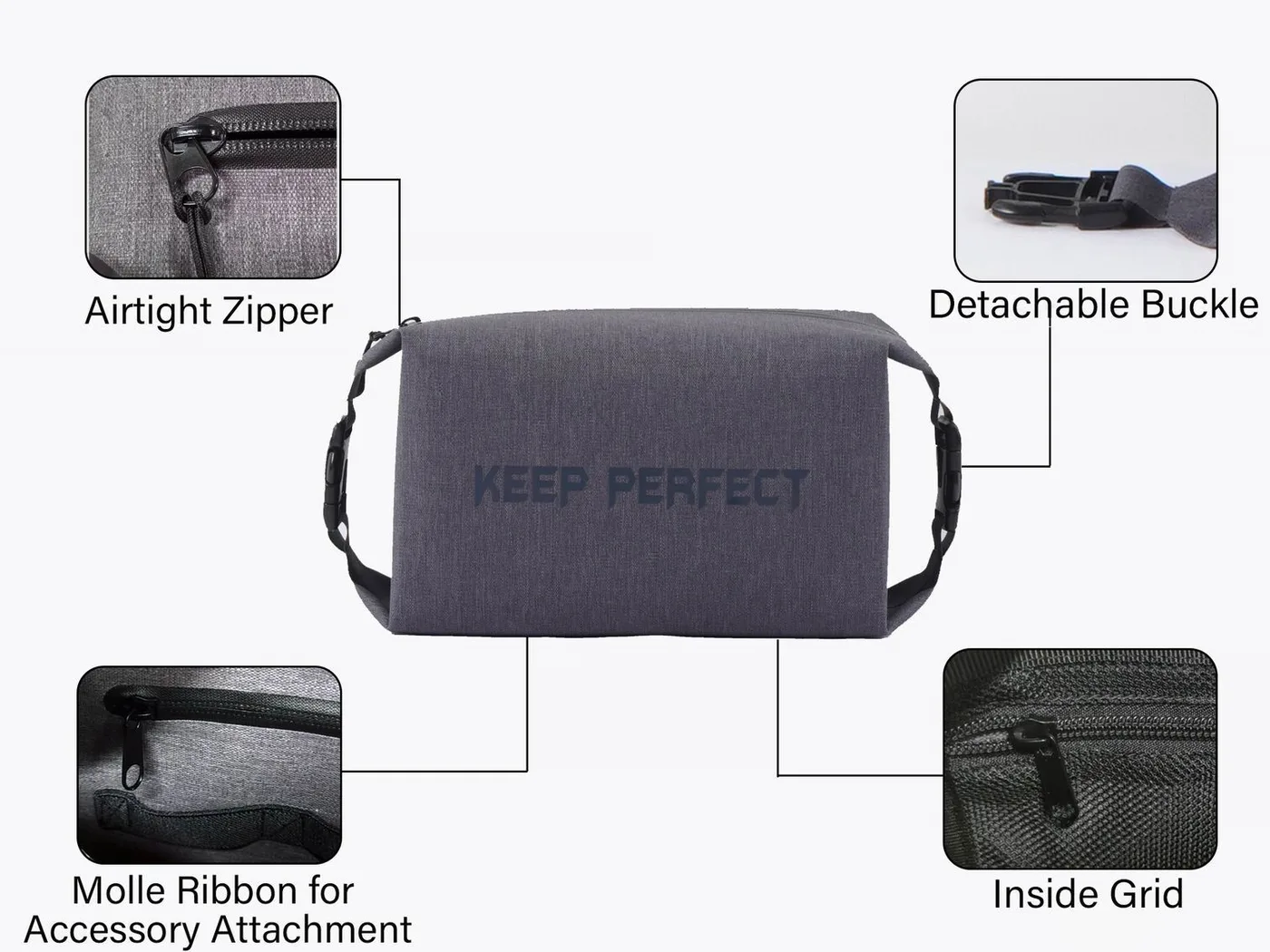
A roll-top dry bag gives the best seal per gram and the fastest open-and-close cycle, but it has no internal organisation at all. A laptop inside a roll-top is only as safe as the sleeve you put around it first. If your day runs from a wet dock or a rain-soaked street to a desk, the roll-top plus a rigid sleeve is the most reliable combination and the easiest to re-pack in a hurry.
A waterproof tote with a built-in padded sleeve solves the organisation problem: the device slides into a dedicated panel, documents stay flat against the back wall, and the mouth still closes against rain. A TPU waterproof backpack spreads the same 2.4 kg across two shoulders, which matters above about 20 minutes of walking. Choose the tote for short urban hops and the backpack for anything over a kilometre on foot.
Padding depth and what a drop test really shows
A 1.4 kg laptop dropped from 0.8 m reaches about 4 m/s and stops in a few millimetres when a corner lands on concrete. Thin neoprene sleeves look tidy and do almost nothing: a 2 mm layer compresses fully in the first 3 ms and passes the remaining shock straight into the corner of the chassis. A 5 mm closed-cell foam or EVA layer spreads the same impact over roughly 25 ms, which is the difference between a dented corner and a cracked board.
Corner protection matters more than face protection, because corners take the hit in almost every real drop. Look for a sleeve with reinforced corners and a lip that stands 5 mm above the device edge, then check that the bag itself has a welded base rather than a folded one; a welded base spreads point loads from gravel, kerbs and boat decks. Pair that with the carrying advice in our laptop protection guide if the device travels on the water.
Documents, folders and the volume nobody counts
Paper is heavier and bulkier than people expect. An A4 sheet is 210 x 297 mm under ISO 216; a ream of 500 sheets of 80 gsm paper weighs 2.5 kg and stacks 52 mm high, so 200 sheets in a folder is about 1.0 kg and 21 mm. Letter-size paper is 216 x 279 mm and slightly narrower, which means a folder cut for A4 will swallow a letter folder but not always the reverse.
Paper also fails differently from electronics. A splash that a laptop would survive destroys a printed contract within seconds, because capillary action pulls water along the sheet edges and the ink runs before the page dries. Carry paperwork in a rigid folder or a slim polypropylene wallet inside the main bag, keep it against the back panel away from the closure, and never let a wet bottle share the same compartment.
| Paper item | Flat footprint | Stack of 100 | Weight of 100 | Protection needed |
|---|---|---|---|---|
| A4 80 gsm sheets | 210 x 297 mm | 10 mm | 500 g | Rigid folder, back panel |
| Passport | 125 x 88 mm | 6 mm each | 40 g each | Sleeve plus inner pouch |
| Boarding passes, 6 | 200 x 90 mm | 3 mm | 30 g | Flat, top access |
| A4 printed contract, 40 pages | 210 x 297 mm | 4 mm | 160 g | Wallet, away from closure |
| Notebook, A5 hardback | 148 x 210 mm | 18 mm each | 340 g each | Corner protection |
Condensation and humidity around a warm device
A dry bag that seals well also seals humidity in. Pack a laptop that has just come out of a 26 °C room, close the bag, then carry it into a 14 °C evening or an air-conditioned terminal at 45% relative humidity, and the trapped air will cross its dew point inside the bag. In practice this shows up as a fine film on the inside of the film wall and, worse, on a cold device screen.
Two habits remove almost all of it. Let the device cool to near ambient before it goes into the bag, and keep a 20 g silica sachet in the same compartment, recharged in a 120 °C oven for an hour every month. If you are travelling between climates with big temperature swings, open the bag for five minutes on arrival rather than pulling a cold machine straight out into humid air.
Rain, splash or immersion: the rating a device needs
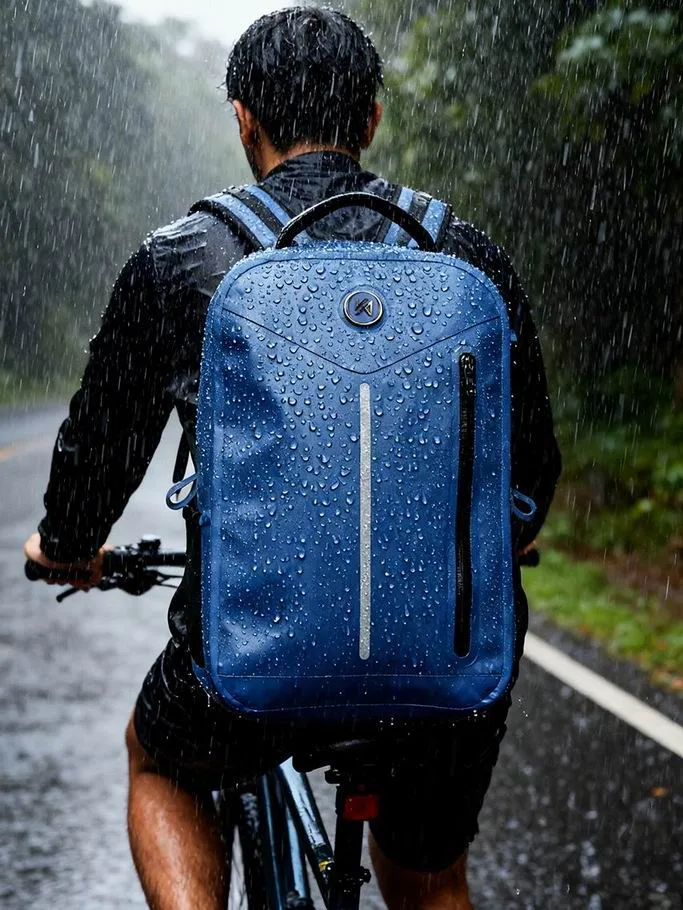
Device loads see two very different exposures. A commute is a rain event: driven water at 5 to 12 m/s from the side, plus the soak you get standing still at a crossing. That is an IPX4 to IPX6 problem. A bag sitting in an open boat or on a paddleboard is an immersion event, which is IPX7. The IEC defines these grades in IEC 60529, so a credible spec sheet names the standard instead of inventing adjectives.
For a laptop, the cheapest insurance is redundancy rather than a higher rating: keep the device in a padded sleeve inside a welded IPX6 bag, and put the passport and phone in a 2L inner pouch. Two independent barriers cost 60 g and remove the single-point failure that ruins a working trip. Full rating detail is in our IPX ratings guide.
Airport security and handling with a loaded bag
Security lanes reward bags that open completely and quickly. A roll-top with three folds is open in about four seconds and lays flat on a tray, which is faster than a long waterproof zip and far less likely to snag. A tote with a separate sleeve panel lets you slide the device out one-handed while the paperwork stays in place, which is worth a lot when the tray queue is moving.
Cabin weight limits are the other half of the problem: a 2.4 kg device load plus a 700 g bag is 3.1 kg before you add a bottle and a jacket, and many regional carriers cap a personal item at 5 kg. Weigh the packed bag at home on kitchen scales, then decide what moves to the hold baggage. Our notes on airport security with dry bags and checking a dry bag on a plane cover the edge cases.
Weight and carry comfort across a working day
Load weight is the variable people underestimate. A 14-inch laptop at 1.6 kg, a 400 g charger, a 500 g folder, a 300 ml bottle and a light shell come to about 2.8 kg before the bag itself. Carry that in one hand in a tote for 800 m and the forearm and trapezius do the work; carry it in a harness with 38 mm padded straps and a sternum strap and the same load is unremarkable over two kilometres.
Strap width is not cosmetic. A 25 mm webbing strap carrying 3 kg puts roughly 12 kPa under the strap contact area and starts to feel sharp after 15 minutes; the same load on a 38 mm padded strap sits near 5 kPa and is comfortable for an hour. If you expect to carry a laptop daily, buy the harness and accept 180 g of extra bag weight.
| Item | Weight | Share of a 4 kg budget | Cut it first if over |
|---|---|---|---|
| 14-inch laptop | 1.6 kg | 40% | No |
| Charger brick and cable | 0.40 kg | 10% | Use a 65 W brick |
| A4 folder, 200 sheets | 1.00 kg | 25% | Scan and carry 40 pages |
| Padded sleeve | 0.21 kg | 5% | No |
| Water bottle, 300 ml | 0.32 kg | 8% | Fill after security |
| Shell and small items | 0.47 kg | 12% | Yes |
Colour, finish and the office test
A bag that goes from a boat to a meeting has to survive two kinds of judgement: abrasion and dress code. Black and charcoal hide scuffing and read as neutral in almost every workplace; mint, pink and camo are excellent on the water and conspicuous in a client lobby. Mid-grey is the compromise that hides salt marks without looking technical.
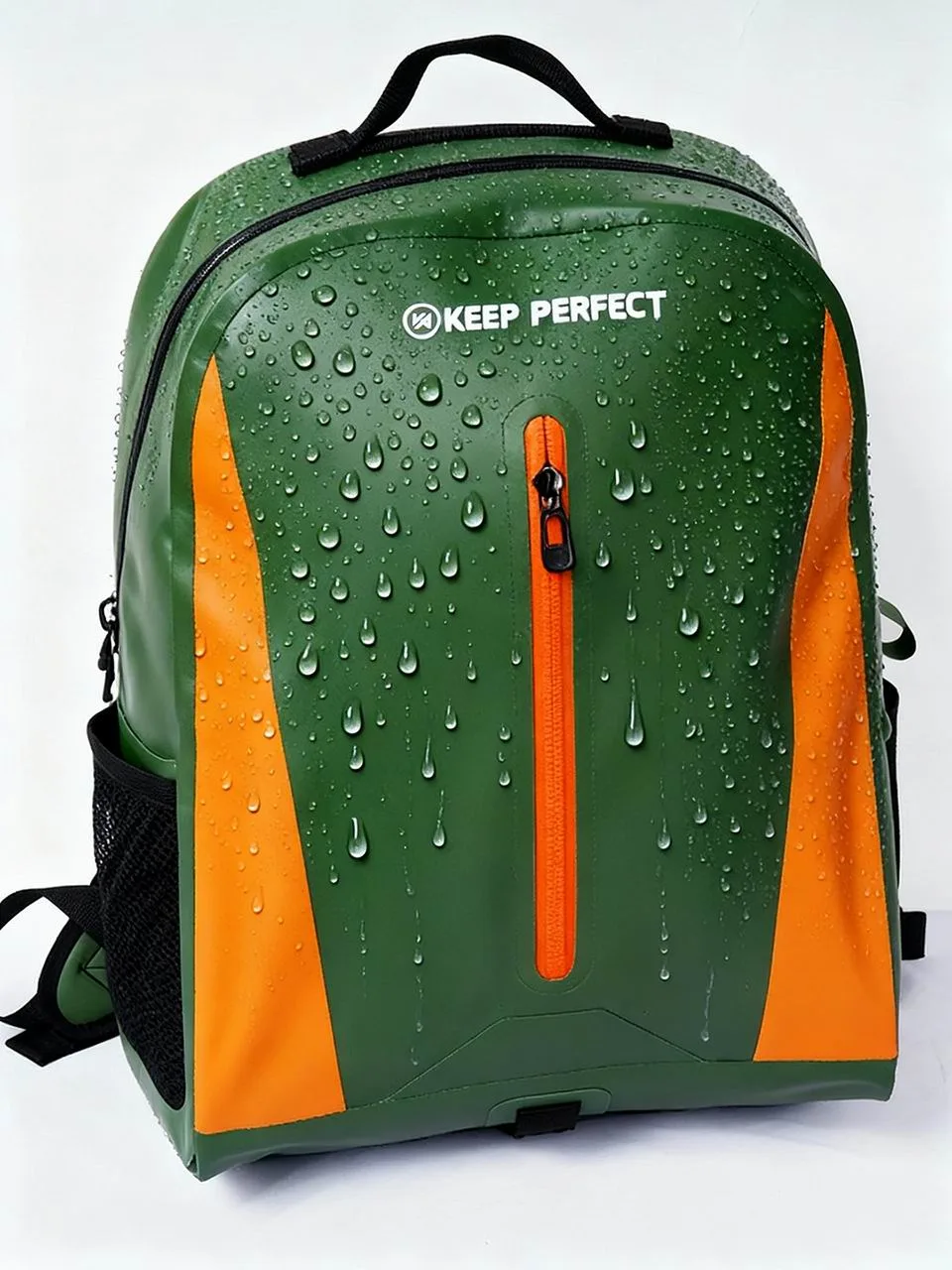
Finish matters as much as colour. A matte TPU face scuffs to a dull patch that can be wiped; a glossy PVC face scuffs to a white mark that cannot. If the bag will spend its life on an office floor, choose matte and add a reflective accent for the walk home; we cover the placement options in reflective accents for night use.
A repeatable pack order for laptop and paperwork
- Slide the cooled device into the rigid sleeve with the corners seated, then check the lip stands proud of the chassis edge.
- Stand the sleeved device against the back panel of the bag, hinge side down, so the spine takes the base load.
- Lay the document folder flat in front of the sleeve, spine up, clear of the closure line by at least 3 cm.
- Drop the charger and cables into a 2L pouch and wedge it beside the folder so nothing can slide to the mouth.
- Press the air out, make three folds, clip the buckle, then lift the bag by the strap and listen for a hiss.
The order is deliberate. Devices go against the back panel because that is the side that stays flattest and takes the least abrasion when the bag is set down. Paper goes in front because it must stay flat. Loose cables go into a pouch because a bare USB-C plug left in the bottom of a bag will print a permanent dent into both the folder and the device lid over a season of commuting.
Care routine for a bag that carries electronics
Electronics introduce a contaminant that outdoor kit does not: conductive debris. Crumbs, staple fragments and paperclip ends find their way into the bottom seam and abrade the weld from the inside. Empty the bag fully once a week, wipe the interior with a damp microfibre cloth, and check the base weld line with a fingertip for grit before it works into the film.
Salt and city grime behave the same way on hardware. Rinse buckles and cam levers with fresh water, work them through their full travel while wet, then dry in shade with the mouth open. Never machine wash a bag that has carried a laptop; the twisting loads the welded seams in a direction they were never tested for. Step-by-step detail is in our roll-top cleaning guide.
Sizing checklist before you commit
- Write down the sleeved device footprint: width, depth and thickness, measured closed.
- Demand a stated flat panel from the bag spec, not just a litre figure.
- Confirm the bag still makes three folds with the device inside; check the height after folding, not before.
- Match padding to risk: 5 mm EVA for daily carry, 2 mm neoprene only for scratch protection.
- Budget the weight: keep the whole load under 4 kg if a shoulder strap is doing the work.
- Plan a second barrier for passport and phone: a 2L inner pouch inside the main bag.
- Choose matte, neutral finishes if the bag splits its life between water and the office.
- Compare the shortlist against the full product line before you settle on one size.
If you are specifying bags for a field team, a rental fleet or a retail range, the same checklist becomes a buying brief: panel dimension, padding depth, closure height after folding, carry weight and the test standard behind the waterproof claim. Our production partner has built waterproof bags since 2014 in an SGS-verified 4,950 m2 facility with 137 staff and seven production lines, working to a 500-piece minimum with sampling in 6 to 10 working days and bulk in 35 to 50 days.
Two neighbouring decisions tend to follow this one. If the load also includes a camera body and lenses, the panel maths changes shape rather than size and the camera kit sizing guide is the better reference. If you are simply deciding between two sizes on the same platform, read dry bag volume versus backpack volume first, because a 20L dry bag and a 20L backpack do not hold the same shaped load.
Frequently asked questions
Q1. What size dry bag do I need for a laptop and documents?
A 13-inch laptop with a folder fits a 15L roll-top; a 14-inch machine with paperwork needs 20L. The deciding number is the flat panel, not the litres: you need at least 36 x 27 cm of usable panel with the closure still able to make three folds.
Q2. Will a 14-inch laptop fit in a 10L dry bag?
No. A 10L roll-top offers roughly 22 x 26 cm of usable flat panel once the folds are made, while a sleeved 14-inch machine is about 33 x 24 cm. It may go in diagonally, but the corners load the film and the closure will not seal cleanly.
Q3. Do I need a padded sleeve inside a dry bag?
Yes. A roll-top dry bag has no internal structure, so the sleeve is the only impact protection the device has. Use 5 mm closed-cell foam or EVA with reinforced corners rather than a 2 mm neoprene slip, which only prevents scratches.
Q4. How much does a laptop load actually weigh?
A 14-inch laptop at 1.6 kg, a 400 g charger, a 1.0 kg A4 folder, a 300 ml bottle and a shell come to roughly 3.5 kg packed. Keep the total under 4 kg if you are carrying it on one shoulder for more than a few hundred metres.
Q5. Can condensation form inside a dry bag with a laptop?
Yes, and it is common when a warm device is sealed into a bag and then carried into cooler air. Let the device reach ambient temperature before packing, add a 20 g silica sachet, and open the bag for five minutes on arrival in a new climate.
Q6. Is a waterproof tote better than a roll-top for documents?
For flat paper, yes. A tote with a padded sleeve panel keeps documents flat against the back wall and lets you lift the device out one-handed at a security tray. A roll-top is the better choice where immersion, not rain, is the risk.
Q7. What waterproof rating should a laptop bag have?
IPX6 for a rain commute, IPX7 if the bag will sit in an open boat or go over the side. Ask for the IEC 60529 test standard behind the claim. For extra safety keep the device in a sleeve inside the bag so there are two independent barriers.
Q8. Will airport security make me open a dry bag?
Usually yes if the device stays inside. A roll-top opens in about four seconds and lays flat on a tray, which is quicker than a long waterproof zip. Slide the sleeved laptop out separately and leave the paperwork in place.
Q9. How do I stop paper getting wet inside a sealed bag?
Use a rigid folder or polypropylene wallet, keep it against the back panel away from the closure line, and never share the compartment with a bottle. Once water reaches a sheet edge, capillary action runs the ink within seconds.
Q10. Does a dry bag protect a laptop from being dropped?
Only through whatever padding you add. The bag film itself offers almost no shock absorption, and a welded base only spreads point loads. Corner-reinforced 5 mm EVA is the practical minimum for daily carry.
Q11. Should I put the charger in the same compartment as the laptop?
No. A bare USB-C plug or a metal cable end left loose will print permanent dents into a device lid and a document folder over a season. Keep cables in a small pouch wedged to one side.
Q12. Can I carry a laptop and A4 folder in a 20L dry bag?
Yes, with room to spare. A 20L roll-top gives roughly 28 x 34 cm of usable flat panel, which takes a sleeved 14-inch machine plus a 200-sheet folder and leaves space for a charger pouch and a bottle.
Q13. What is the heaviest sensible daily carry for a shoulder bag?
About 4 kg including the bag. Above that, switch to a harness with 38 mm padded straps and a sternum strap; a 25 mm webbing strap at 3 kg already produces noticeable pressure after 15 minutes.
Q14. How often should I clean a bag that carries a laptop?
Empty it fully once a week and wipe the interior, because crumbs and metal fragments abrade the base weld from the inside. Rinse hardware with fresh water monthly, and never put the bag in a washing machine.
Q15. Is TPU or PVC better for a commuter laptop bag?
TPU. It stays flexible in cold mornings, has no plasticiser to migrate onto a device finish, and wipes clean of city grime. PVC is heavier per square metre and scuffs to a permanent white mark on glossy faces.
Q16. What colour hides wear on a daily work bag?
Matte charcoal or mid-grey. Both hide salt marks and scuffs and read as neutral in an office, while glossy finishes scuff visibly and bright colourways draw attention in a client setting.
People also ask
How do you pack a laptop in a dry bag?
Cool the device first, slide it into a 5 mm padded sleeve, stand it against the back panel hinge-down, lay documents flat in front, pouch the cables, press the air out and close with three folds. Keep the folder at least 3 cm clear of the closure line.
Are dry bags safe for electronics?
They are safe against water and poor against shock. Film gives no impact absorption, so electronics need a padded sleeve plus a second inner pouch for phone and passport, and a silica sachet if the temperature will swing during the day.
What size is an A4 folder in a bag?
A closed A4 folder is about 31 x 23 cm and 22 mm thick with 200 sheets, and it weighs roughly 1.0 kg. Add a rigid wallet and it behaves like a second laptop in the bag, which is why 20L is the practical minimum for device plus paper.
Can you take a dry bag as a personal item on a plane?
Yes, and a roll-top packs softer than a framed case. Weigh the loaded bag first: a 2.4 kg device load plus a 700 g bag is 3.1 kg before a bottle or jacket, and regional carriers often cap a personal item at 5 kg.
Do laptops overheat inside a sealed dry bag?
Not if they are switched off or asleep. A running machine in a sealed bag in direct sun can reach 45 °C internally within 20 minutes, so never close a bag around a device that is powered on and working.
Why does my dry bag feel damp inside after a commute?
Almost always condensation, not a leak. Warm humid air sealed inside the bag crosses its dew point when the outside temperature drops, and the moisture condenses on the coldest surface, which is usually the device screen.
Need this in production volume?
QUANZHOU JUNYUAN BAGS has produced waterproof bags since 2014 in an SGS-verified 4,950 m2 facility in Fujian, China. Minimum order 500 pieces, sampling in 6–10 working days, bulk in 35–50 days, FOB Xiamen — write to service@junyuanbags.com with your spec and target market.