Choosing a Dry Bag for Waterfall Hiking
A waterfall hike wets gear differently from ordinary rain. Within 15 metres of a 20 m falls the air carries enough drift to soak a pack cover in about 20 minutes and to put 200 to 400 ml of water into an open-top daypack over four hours, and the spray arrives sideways from below rather than from above. For that exposure you want a welded bag rated IPX6 or better, sized at 15 to 25 litres for a day at the falls, with three rolls closed and the fold turned away from the spray.
This guide compares the formats that work on wet granite, explains why the exposure gradient near a falls changes the rating you need, and sets out the sizing, closure and fabric decisions in order of impact. It also covers the failure modes specific to waterfall trails: condensation inside a sealed bag, straps that slip on wet rock, and camera gear taken to the spray line. Every recommendation is tied to a measurable figure so you can check it against your own route.
- How waterfall spray differs from ordinary rain
- How much water actually reaches your kit
- Sizing for a day at the falls
- Format: roll-top, backpack or duffel on wet rock
- Closure orientation and how many rolls
- Condensation: the water that comes from inside
- Fabric and film that survive wet granite
- Straps, harness and carrying on slippery ground
- Camera and phone at the spray line
- Weight budget and the scramble penalty
- What fails first on a waterfall trail
- Ratings, weather and the decision to turn back
- Choosing checklist for a waterfall day
How waterfall spray differs from ordinary rain
Rain falls vertically at a terminal velocity of roughly 6 to 9 m/s and is relatively easy to shed. Waterfall drift behaves differently: the plume is generated by the impact of the water at the base, so it moves outward and upward, arrives at head height, and carries a fine aerosol that stays suspended for minutes. That aerosol is the problem, because particles in the 50 to 500 micron range settle into closures, zip garages and buckle channels rather than running off a shell.
The second difference is duration and salt-free chemistry. Rain is intermittent; a falls runs continuously, so the load is steady for as long as you stay near it, typically 30 to 90 minutes per viewpoint across a full day. Freshwater has lower surface tension than saltwater, which lets it wick further into a seam or a stitch line once it has found an entry point. Packs that survive a shower therefore routinely fail at a falls.
| Zone near a 20 m falls | Distance | Approximate drift load | Rating that holds |
|---|---|---|---|
| Plume edge | 0-5 m | 80-150 ml per 10 min | IPX7, welded |
| Spray line | 5-15 m | 20-60 ml per 10 min | IPX6, welded |
| Mist zone | 15-40 m | 5-20 ml per 10 min | IPX5 to IPX6 |
| Damp trail | 40-100 m | 1-5 ml per 10 min | IPX4 |
| Above the falls | Over 100 m | Rain only | IPX4 to IPX5 |
Use the table as a planning tool rather than a rule. A narrow gorge amplifies drift because the walls confine the plume, while an open cascade in wind disperses it, so the same nominal distance can differ by a factor of three between two sites. If in doubt, specify one rating higher than the zone suggests and spend the saving on a lighter pack elsewhere.
How much water actually reaches your kit
Measure the problem before buying for it. A 30-litre daypack with a coated shell and no closure absorbs 150 to 300 g of water in the shell alone over two hours of continuous mist, and adds whatever runs in through the lid gap, which at the spray line is another 100 to 200 ml. That is a third of a kilogram of dead weight and a wet sleeping layer at the end of the day, which is the outcome people are trying to avoid.
A sealed roll-top changes the arithmetic entirely because the bag simply never takes water on. The comparison is worth doing with your own kit: weigh your pack dry, walk a wet gorge route for two hours, and weigh it again. Most people are surprised by a 300 to 500 g gain, and that number is the honest starting point for judging whether a waterproof system is worth carrying.
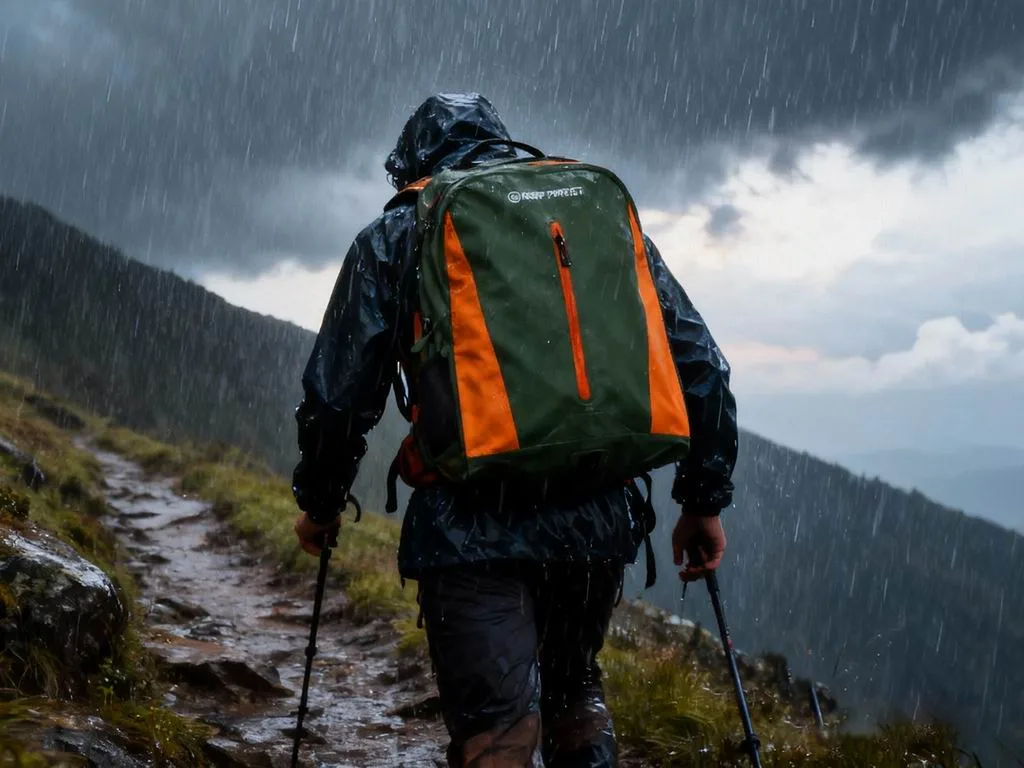
Sizing for a day at the falls
Waterfall routes are day hikes with a short approach and a lot of standing around, which shapes what you carry. The load is dominated by insulation and camera gear rather than by food and shelter, because you stop often in shade and lose heat quickly while stationary. Most people find 15 to 25 litres of waterproof volume covers a full day, split across two bags rather than carried as one.
| Hike type | Hours out | Waterproof volume | Typical packed weight | Suggested split |
|---|---|---|---|---|
| Short gorge walk | 2-3 h | 10-15 L | 1.8-2.6 kg | 1 x 15L |
| Full waterfall loop | 4-6 h | 18-25 L | 2.8-4.0 kg | 1 x 20L + 1 x 5L |
| Falls plus swim stop | 5-7 h | 25-35 L | 3.6-5.0 kg | 1 x 20L + 1 x 10L |
| Photography day | 6-8 h | 30-40 L | 5.0-7.5 kg | 1 x 30L + 1 x 10L |
| Wet overnight camp | 2 days | 45-60 L | 8-11 kg | 1 x 40L + 2 x 10L |
Two mid-size bags beat one large one on this terrain, because waterfall routes involve scrambling and a single bulky load moves your centre of gravity backwards exactly where you need it forward. A 20L bag worn high and a 5L grab bag clipped to the shoulder strap lets you shed the small one at each viewpoint without unpacking the large one. Volume guidance for the common sizes is collected in what fits in a 20L bag and what fits in a 15L bag.
Format: roll-top, backpack or duffel on wet rock
Format is an access decision once waterproofing is solved. A waterproof backpack with welded seams and a roll-top mouth carries a 4 kg load comfortably over 8 km of approach trail and keeps both hands free for scrambling, which matters on wet granite where a hand on rock is worth more than a hand on a strap. The roll-top mouth is slower to open than a lid but sheds water rather than collecting it.
A dry duffel is the wrong shape for this terrain because it needs two hands and a flat surface to open, and neither is available on a wet ledge. A small roll-top sack carried inside a pack is the better compromise: it protects the load if the pack shell wets through, and it can be pulled out and set down anywhere. The trade-off between the two formats is set out in dry bag backpack versus dry duffel.
Closure orientation and how many rolls
Point the roll away from the water. On a waterfall trail that usually means folding the top forward and downward so the closure faces your body rather than outward toward the plume, because a closure pointed into drift collects aerosol in the fold and feeds it inward over an hour. Three rolls is the working standard: two hold a shower, three hold spray and a brief dunk in a plunge pool, four shortens usable volume without adding meaningful protection.
Roll height matters as much as roll count. Always folding at exactly the same place puts every crease into one line of film, and that line is where cracking eventually starts; varying the roll by 10 to 20 mm spreads the fatigue over a wider band and costs nothing. Check the fold for grit before closing, since one grain in the third fold is enough to admit 30 to 60 ml over a few hours.
Condensation: the water that comes from inside
The most confusing wet-bag experience on a waterfall hike is finding moisture inside a bag that never went in the water. It is condensation, and the physics is simple: a bag packed with a damp jacket at 22 °C and then carried into 12 °C shade near the falls drops below the dew point on its inner surface, and the water vapour in the trapped air condenses there. A 20L bag with 90% humidity air inside can deposit 5 to 15 ml overnight or over a cold afternoon.
The fix is to keep damp items out of the sealed volume. Pack the wet shell in a separate open bag, press as much air as possible out of the dry bag before rolling, and if the bag has a purge valve, use it after packing rather than after closing. Silica gel is a genuine help for electronics: 20 g of desiccant protects a camera body for a full day in a 10L bag. More detail is in condensation inside a dry bag.
Fabric and film that survive wet granite
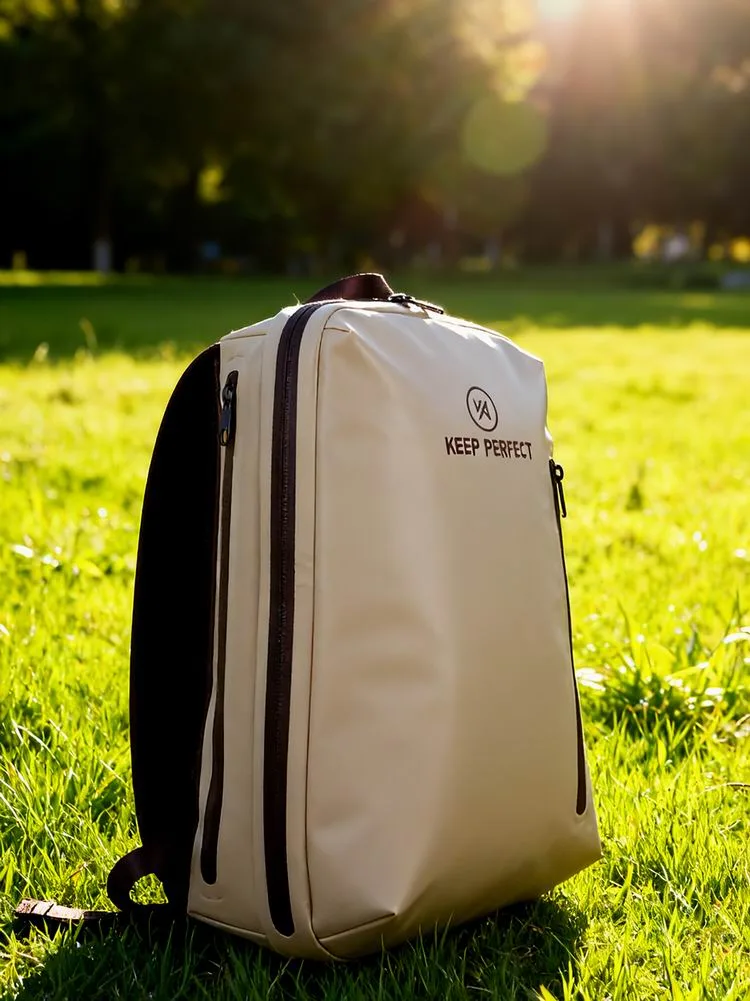
Two variables decide service life on this terrain: film thickness and face fabric, in that order. Wet granite is abrasive in a way dry granite is not, because water carries grit into the contact patch and turns it into a lapping paste. A 0.5 mm film with a 420D face survives 10,000 to 14,000 abrasion cycles in standard testing, while 0.3 mm manages 3,000 to 4,000, and that gap is the whole difference between a bag that lasts a season of weekly gorge walks and one that lasts five.
| Construction | Weight per square metre | Abrasion cycles to visible wear | Wet grip | Verdict for waterfall routes |
|---|---|---|---|---|
| 210D face, 0.3 mm TPU | 255 g | 3,000-4,000 | Good | Internal organisers only |
| 420D face, 0.4 mm TPU | 390 g | 6,000-8,000 | Good | Acceptable for light day use |
| 420D face, 0.5 mm TPU | 480 g | 10,000-14,000 | Very good | Best all-round choice |
| 500D face, 0.5 mm TPU | 540 g | 12,000-16,000 | Good | Best for camera loads |
| PVC coated 500D | 620 g | 5,000-7,000 | Slippery when wet | Avoid on scrambles |
Wet grip is the underrated column. A bag with a slick PVC face slides off a wet boulder and off your shoulder, and it is harder to hold while you clip it to a strap at a viewpoint. TPU keeps a higher coefficient of friction when wet, which is the practical reason experienced gorge walkers prefer it even before abrasion numbers are considered.
Straps, harness and carrying on slippery ground
Harness design matters more here than on a dry trail because you are constantly putting the bag down and picking it up on surfaces that offer little friction. Look for a sternum strap and a hip belt that can be tightened with one hand, shoulder straps at least 50 mm wide at the top, and a grab handle at the base so you can pull the bag off a ledge without touching the film with wet, gritty hands.
Lash points should be welded rather than sewn, because a sewn loop on a waterproof shell is a leak path as well as a weak point. Welded D-rings on a 0.5 mm TPU body take a 25 mm strap and a shock load in a slip without tearing; the same loop stitched through the film fails at 60 to 80 kg and lets water in through the needle holes. Attachment geometry is covered in D-rings and lash points.
Camera and phone at the spray line
Photography is the reason most people carry expensive kit to a falls, and the spray line is the worst possible place for it. A camera body plus one lens packs to about 1.8 litres and 1.1 kg, and it needs two independent barriers: an inner 5L roll-top with a desiccant sachet, inside a 20L or 30L bag whose closure faces away from the plume. Change lenses inside the inner bag, never in open air at the viewpoint.
Phones are simpler and more frequently lost. A 2L roll-top holds a phone, keys and a small wallet, clips to a shoulder strap, and is the one bag you open twenty times a day, so it should be the easiest to close rather than the most protective. Keep it on the strap rather than in a pocket, since a phone dropped from a wet ledge is gone whether or not it was waterproof. Practical layouts are in camera gear in a dry bag.
Weight budget and the scramble penalty
Every kilogram costs more on a waterfall route than on a graded trail, because the walking alternates between flat path and hands-on scrambling. The working ceiling for a day load is about 15% of body weight, so a 70 kg hiker should be carrying no more than 10.5 kg including water, and a 20L dry bag system that adds 500 g over a standard pack has to earn that by keeping everything else dry.
Decide where to spend the weight. Film thickness is worth 90 g on a 20L bag for the abrasion life it buys. A separate wet-volume bag is worth 150 g because it stops condensation. A second dry bag for redundancy is worth 200 g because a single failure on a wet mountain is a genuine problem. What is not worth carrying is a heavy pack cover, which protects the shell while doing nothing for the contents.
What fails first on a waterfall trail
Field failures on this terrain follow a consistent pattern, and almost none of them starts with the fabric letting water through. The commonest is a closure rolled over a wet, gritty fold. The second is a sewn seam or a stitched lash point wicking water inward over an hour. The third is a strap adjuster packed with grit that slips under load, dropping the bag onto rock at exactly the moment you are balanced on it.
| Failure | Cause | Warning sign | Fix |
|---|---|---|---|
| Closure seep | Grit in the third fold | Damp patch under the roll | Rinse the fold, re-roll clean |
| Wicking at a seam | Stitched rather than welded | Damp line inside the corner | Retire from wet use or re-weld |
| Strap slip | Grit in the adjuster | Bag settles every few minutes | Flush the adjuster, re-tension |
| Abrasion at the base | Set down on wet granite | Glossy patch, then fuzz | Patch, and use a mat |
| Condensation | Damp gear sealed inside | Moisture with no leak path | Separate wet volume, add desiccant |
The discipline that prevents all five is a two-minute check at each transition: before you leave the car, after the first viewpoint, and before the scramble section. Look at the fold, feel the adjusters, and glance at the base corners. Bags rarely fail without telling you first, and the sign is nearly always visible a session before the leak appears.
Ratings, weather and the decision to turn back
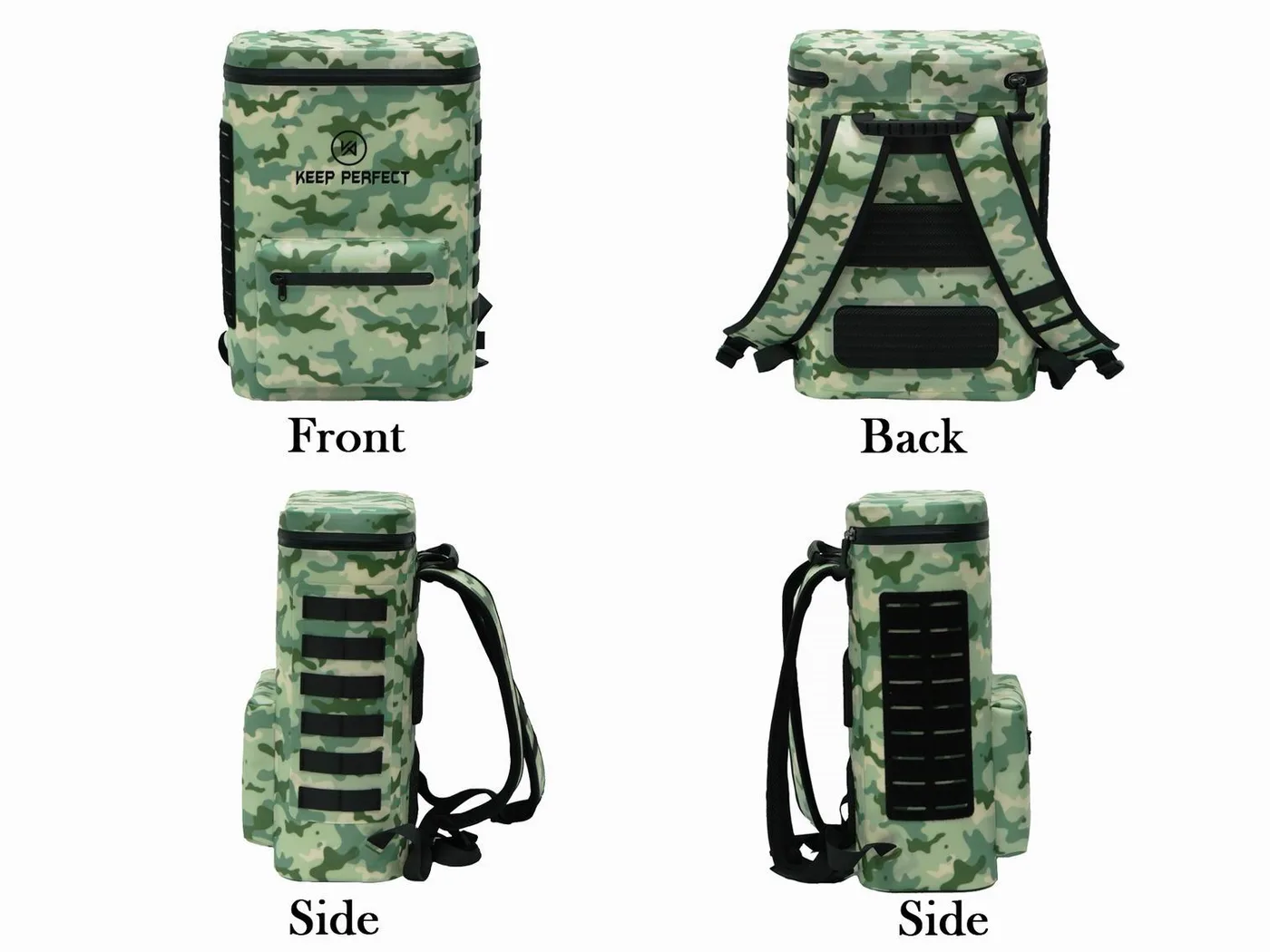
A credible waterproof claim names the test. IPX5 covers water jets from a 6.3 mm nozzle, IPX6 covers powerful jets from a 12.5 mm nozzle, and IPX7 covers 30 minutes of immersion at one metre; the grades are defined in IEC 60529 by the ISO and IEC system and are worth quoting rather than paraphrasing. For a waterfall day, IPX6 is the minimum and IPX7 is the sensible target, because plunge pools and slips turn jet exposure into immersion without warning.
Be sceptical of claims that describe a feeling rather than a method. “Stormproof” and “all-weather” mean nothing, whereas a hydrostatic head figure in millimetres and a named immersion or jet test can be compared between two bags. The difference between protection from rain and protection from submersion is explained in rain versus submersion, and the entry routes are catalogued in how water gets into a dry bag.
Waterfall routes change character with rainfall, and a gorge that is pleasant on a dry afternoon can become dangerous two hours after heavy rain upstream. Catchment flow responds faster than most walkers expect, and a small increase in depth translates into a large increase in force on your legs at a crossing. Check rainfall and forecasts through NOAA before committing to a narrow gorge route with water crossings.
Freshwater contact carries its own health considerations, especially after swallowing or immersion with open cuts, and the CDC publishes guidance worth reading before a season of swimming in plunge pools. None of that is a dry bag question, but it is the reason to keep a small first-aid kit in the 2L bag that never leaves your strap rather than in the bottom of the main load.
Choosing checklist for a waterfall day
- Rate for the spray line, not for the forecast: IPX6 minimum, IPX7 preferred.
- Size at 15 to 25 litres for a day, split across two bags rather than one.
- Welded seams and welded lash points; no stitched load-bearing loops.
- 0.5 mm film with a 420D or 500D face for anything set down on wet rock.
- Roll three times, vary the fold height, and point the closure away from the plume.
- Keep damp gear in a separate open volume to stop condensation.
- Carry camera kit in an inner 5L bag with 20 g of desiccant.
Work through the list with your actual route in mind rather than in the abstract. A two-hour gorge walk on a boardwalk needs far less bag than an eight-hour photography loop with three scrambles, and buying for the hardest day you can imagine usually means carrying 700 g you did not need on every other outing. Buy for the 80th percentile trip and rent or borrow for the outlier.
If you are specifying bags for a guiding operator, a walking club or a retail range aimed at wet-weather routes, the same seven lines become a brief: rating, volume split, seam type, film and face fabric, closure discipline, condensation strategy and electronics protection. Our team has produced waterproof bags since 2014 in an SGS-verified 4,950 m2 facility with 149 machines, a 500-piece minimum and sampling in 6 to 10 working days.
Two comparisons round this off. Hikers moving from trail use to wet routes should read choosing a dry bag for thru-hiking for the weight discipline, and anyone torn between closure types should read roll-top versus zipper. Then compare formats in the roll-top dry bag range or browse the full product line.
Frequently asked questions
Q1. What size dry bag do I need for a day hiking to waterfalls?
Plan on 15 to 25 litres of waterproof volume for a four to six hour loop, split as a 20L bag plus a 5L grab bag. Photography days with a camera body and lens push that to 30 to 40 litres.
Q2. Is IPX6 enough at a waterfall?
IPX6 is the minimum and covers powerful jets from a 12.5 mm nozzle, which is what spray line drift resembles. Choose IPX7 if your route includes plunge pools, stream crossings or any chance of a slip into deep water.
Q3. Why is my dry bag wet inside when it never went in the water?
Condensation. Air sealed inside at 22 °C and carried into 12 °C shade drops below its dew point on the inner film, depositing 5 to 15 ml in a 20L bag. Keep damp items in a separate open bag and press the air out before rolling.
Q4. Should I take a waterproof backpack or a dry bag in a pack?
A welded waterproof backpack for the approach, with a small roll-top sack inside for what must stay dry. The pack carries the load comfortably; the inner sack protects it if the shell wets through or you set the pack down on wet ground.
Q5. How many rolls should I use near a waterfall?
Three. Two hold a shower, three hold continuous spray and a brief dunk, and four reduces usable volume without adding protection. Vary the roll height by 10 to 20 mm each time so the crease does not always land in the same line.
Q6. Which way should the closure face?
Away from the water. Fold the top forward and downward so the roll faces your body rather than the plume, since a closure pointed into drift collects aerosol in the fold and feeds it inward over an hour.
Q7. Is TPU or PVC better for wet granite?
TPU, for two reasons: a 420D face with 0.5 mm film reaches 10,000 to 14,000 abrasion cycles against 5,000 to 7,000 for PVC, and it keeps a higher coefficient of friction when wet, so it does not slide off a boulder or a shoulder.
Q8. Can I put a wet rain shell in my dry bag?
No. It will wet everything else through condensation and direct contact. Carry a separate open volume of 10 to 20 litres for anything that is already wet, and rinse and dry that bag first at the end of the day.
Q9. How do I protect a camera at the spray line?
Use two barriers: an inner 5L roll-top with a 20 g desiccant sachet, inside a 20L or 30L bag whose closure faces away from the water. Change lenses inside the inner bag, never in open air at the viewpoint.
Q10. How much weight should a waterfall day load be?
Keep the total to about 15% of body weight, so roughly 10.5 kg for a 70 kg hiker including water. Spend weight on film thickness and a second bag; do not spend it on a pack cover that protects the shell and not the contents.
Q11. Do stitched seams leak at waterfalls?
They wick. A stitched seam or lash point gives water thousands of capillary paths, and the effect is slow enough to be missed in a shower but obvious after an hour of continuous mist. Choose welded construction for wet routes.
Q12. What is the smallest useful dry bag on a hike?
A 2L roll-top: it holds a phone, keys and a small wallet, clips to a shoulder strap, and is the bag you open most often. Anything smaller is better used as an organiser inside a larger bag.
Q13. How do I stop my bag sliding off wet rock?
Choose a TPU face rather than slick PVC, look for a base grab handle so you can lift rather than drag, and never set the bag directly on granite if you can avoid it. A 10 mm foam sit pad weighs 60 g and protects the base corners.
Q14. Will spray damage a printed logo or a coloured bag?
Constant freshwater mist will not damage a welded print, but prolonged ultraviolet exposure between trips will fade pale colours fastest. Rinse, dry in shade, and store out of direct sun to keep a colour range consistent.
Q15. Should I buy one large bag or two mid-size bags?
Two. A single bulky load shifts your centre of gravity backwards, which is wrong for scrambling, and two bags give redundancy if one closure is compromised. A 20L plus a 5L covers most waterfall days.
Q16. When should I turn back on a waterfall route?
When flow has visibly risen after upstream rain, when a crossing is above knee height with force behind it, or when the rock is running with water. Catchment levels respond to rainfall faster than most walkers expect.
People also ask
How do you keep a camera dry at a waterfall?
Double-bag it: an inner 5L roll-top with 20 g of desiccant inside a 20L or 30L welded bag, with the closure facing away from the spray. Change lenses only inside the inner bag, and wipe the outer bag dry before opening it at the car.
Are dry bags worth carrying on a day hike?
Yes on wet routes, because a coated daypack typically gains 300 to 500 g of absorbed water over two hours of continuous mist. A sealed roll-top adds no water weight at all and pays for itself in dry layers at the end.
What waterproof rating do you need for waterfall spray?
IPX6 for the spray line and IPX7 if there is any chance of immersion. Spray resembles a directed jet rather than rainfall, and a slip into a plunge pool converts jet exposure into submersion instantly.
Can you use a dry bag as a daypack?
A roll-top dry bag with a welded harness works as a small daypack, but a waterproof backpack carries better over 8 km. Many hikers run both: a backpack for comfort and an inner sack for guaranteed dry storage.
Why does water get into a sealed dry bag?
Three routes: grit in the fold creating a capillary path, condensation from damp contents, or wicking through stitched seams. Welded seams and a clean, dry fold eliminate the first and third; separating wet gear handles the second.
How heavy is a waterfall day load in a dry bag?
A four to six hour loop with insulation, food, water and a small camera kit packs to 2.8 to 4.0 kg in 18 to 25 litres. Adding a full camera body and lens takes it to 5 kg and about 30 litres.
Need this in production volume?
QUANZHOU JUNYUAN BAGS has produced waterproof bags since 2014 in an SGS-verified 4,950 m2 facility in Fujian, China. Minimum order 500 pieces, sampling in 6–10 working days, bulk in 35–50 days, FOB Xiamen — write to service@junyuanbags.com with your spec and target market.